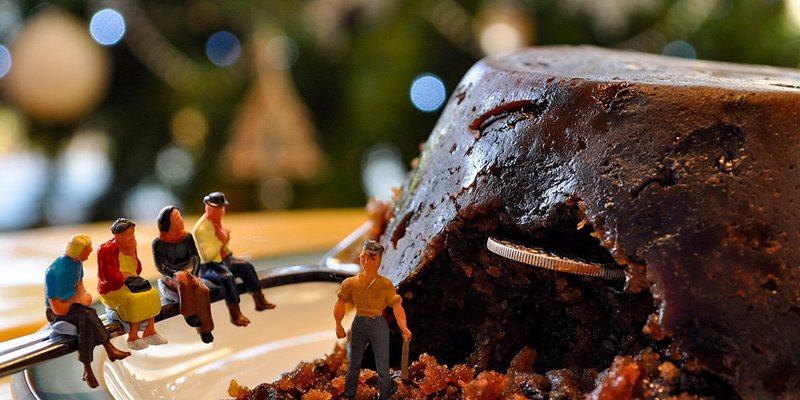

Coins and trinkets are baked into a King Cake, eaten in Portugal, Spain and across Latin America on 6 January to mark Epiphany. In Macedonia, on Kolede’s Eve (5 January) a coin is similarly hidden in bannock bread, and whoever finds it in their slice is named Best Person and given the responsibility for lighting the Kolede’s Eve bonfire.
Spanish and Italian Christmas and New Year’s cuisine features lentils that represent coins—signifying wealth and good luck—often used to make festive soups. The tradition has since been carried to the U.S., where leafy greens are also included thanks to their supposed resemblance to American banknotes. In the Czech Republic, fish scales symbolising silver coins are placed beneath plates during the traditional fish-based Christmas Eve meal, to bring prosperity to the home.
In the UK, families of old stirred a sixpence into their Christmas pudding mixture, and whoever found the coin would supposedly enjoy wealth and good fortune in the coming year. The custom is thought to have been brought to Britain by Prince Albert, the German consort of Queen Victoria, and continues to this day, having also spread to Australia and Canada. Unsurprisingly, there is a common associated Google search: “is it safe to put coins in Christmas pudding?”